Showing posts with label stereotypes. Show all posts

Monday, April 19, 2010

Glee?

Glee began it's second installment of it's first season last week, and I feel the desire to weigh in on this show a bit. There's plenty of controversy about the show, if you haven't watched it or heard the music or been in a flash mob:

A high-school Spanish teacher becomes the director of the school's Glee club, hoping to restore it to its former glory. It's all a seemingly happy-go-lucky melange of high school stereotypes acting and interacting and singing songs that get your feet tapping and hearts melting,

but there's more...

Sue Silvester-
The evil cheerleading coach tries to undermine the glee club at every turn with blackmail and constant evil scheming;

Mrs. Scheuster-
the glee club sponsor's wife becomes hysterically pregnant and then spends the entire first season lying and manipulating the poor teacher to avoid telling him the truth, egged on by her sister;

Miss. Pillsbury-
the sweet obsessive compulsive guidance counsellor is in love with the glee club sponsor but instead of telling him, she accepts the gym coach's offer of marriage and lies to him about her feelings for the glee club sponsor for many episodes until she jilts him;

Quinn-
the head cheerleader (and president of the celibacy club) cheats on her boyfriend, the glee club's lead tenor and the football team's quarterback, with the ne'er-do-well rogue and becomes pregnant, and instead of owning up tells the quarterback that it must have happened when they were making out in a hot tub... then concocts a plan with the glee club sponsor's wife to have her secretly adopt the cheerleader's baby and lie to both the quarterback and glee club sponsor;

Tina-
the Asian girl fakes a stutter for her entire life and then admits it to her disabled friend in a wheelchair assuming that he'd understand because he's disable why she's lied about herself for attention;

Rachel-
the annoying drama queen nerd lead soprano is in love with the quarterback/lead tenor but doesn't say anything about it, instead, choosing a campaign of white lies and makeovers that keep either person from realizing that the other actually likes them;

Mercedes-
and oh, the African-American Diva shoplifts under the watchful eyes of an aging glee club star (April) who comes in to help coach the club for an episode, and instead of telling the quarterback when she finds out that the cheerleader's baby isn't his, tells everyone but him;

Now, I enjoy this show, it's really entertaining and has one of the sweetest portrayals of a young homosexual man and his father on TV. I've seen every episode, but... why is every woman in it portrayed as a liar?

The only one who takes responsibility for her behavior is the Quinn who decides to raise the baby herself, after all other options fall apart because of the web of lies. Though that seems at the moment to mostly means she's constantly chasing women away from the ne'er-do-well baby-daddy.

I want the rest of the season to show consequences but I'm not terribly optimistic about it based on how mendacity is an innate quality of women in Glee so far... and so far the Rachel and Ms. Pillsbury got the guys (temporarily) there were no visible consequences of Tina's or Mercedes' plots, and Mrs. Schuester is trying to lie and manipulate Mr Schuester's life through Ms. Pillsbury.

The male characters are pretty scrupulously honest and tend to come off as victims most of the time, despite their involvement in schemes.

Sue is even rewarded for her lying and scheming, actually, at least twice per episode up to this point, but I suspect that's because she's honest with herself about being a liar.

Am I the only one who has noticed this? I feel like I'm taking crazy pills.

Sunday, January 3, 2010

Sex Sells?

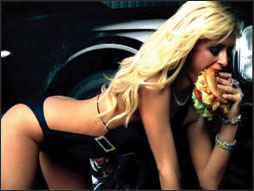
Sex! Look at that image, all sexy, alluring, drawing your eye.... for all of 10 seconds...

This article made me rather happy to read.

You’re not surprised, of course, because there’s nothing new about this. Sex has been selling products other than sex since products other than sex have been sold. The current sex-obsessed Axe body spray commercials are simply an updating of the Hai Karate commercials of yesteryear. Granted, today’s commercials demonstrate a greater corporate tolerance for pseudo-pornographic content, but that’s primarily a function of the increased difficulty of attracting eyeballs in the digital age. We’re not looser than we used to be: we’re just more desperate for attention.

So sex sells. That’s nothing new. But the use of sex to sell nonsexual products is also atell. To understand what you’re being told when you see sex in a commercial for a nonsexual product, you need to know Barrett’s First Law of Marketing:

When your product is indistinguishable from the competition, add sex.

To get real brand recognition for an indistinguishable product in a generic market you need to do something radical — like mate a partially nude, gyrating, grinding, blond bimbo to a bucket of suds, so nature can take its course with whatever demographic (dad and his wallet) you’re trying to attract. That’s how everything from toasters to antiperspirant to shoes to cars to dental floss to insurance to fast food becomes steeped in curves and innuendo. It’s not that sex sells everything, it’s that sex helps sell stuff that otherwise cannot compete on its own merits.

Which leads us to the inverse of Barrett’s First Law of Marketing:

If sex is used to market a nonsexual product, that product is generic.

To put it bluntly, sex in commercials is increasingly making companies look like desperate attention whores. Frankly, people, and young audiences specifically are getting less and less willing to buy it.

From CNN's Graphic Sex and Nudity Don't Sell at the Movies:

A recent study concluded that nudity and explicit sex scenes don't translate to success for major motion pictures.

"Sex Doesn't Sell -- nor Impress! Content, Box Office, Critics, and Awards in Mainstream Cinema" examined more than 900 films released between 2001 and 2005.

The study found that, contrary to popular belief, sex and nudity failed to positively affect a film's popularity among viewers or critics and did not guarantee big box office receipts.

One of the study's co-authors, Dean Keith Simonton, said theirs was the largest sample of its kind used for film research. The results surprised him, he said.

"Sex did not sell, whether in the domestic or international box office, and even after controlling for MPAA rating," said Simonton, who is a professor of psychology at the University of California, Davis. "In other words, even among R movies, less graphic sex is better."

GASP!

"Nothing is as shocking anymore," Detweiler said. "You can see it in Britney Spears' kiss with Madonna and Janet Jackson's Super Bowl performance. Things that were a big controversy among some, the next generation kind of yawned at it."

This leads me to hope, I like hope, I even liked it before it was a trendy campaign slogan, and I still like it now that people hate on it because the world wasn't magically fixed by hope. While more kids want to be "celebrities" these days, and "celebrity" increasingly means "desperate attention whore" young people seem somewhat inured to the bombardment of sexually explicit imagery foisted upon them.

Like bacteria mutating to become resistant to certain types of drugs, audiences are constantly changing, and they have been exposed to enough marketing to become resistant to certain types of "extreme" attention grabs. Audiences increasingly want to interact with their entertainment and when limited thrills are all a product is offering, not distinguishing itself in any other way, there's no incentive to follow up. Audiences and Consumers are becoming increasingly sophisticated in how they receive advertising and how they are lured into seats and purchases.

As I stated in my post about Jennifer's Body last year, if you aren't effectively describing what you're selling, you're not doing it right. Even something with substance can be undercut by a bad marketing campaign, and stereotyping the characters in a narrative, like that a female character is only sexual, or that a 30 year old man is only interested in football and sex, objectifies both character and audience, doesn't allow any lasting connections to be made between the two and alienates a lot of potential audience members.

These studies show once again that stereotyping, limiting the scope of what one is presenting and going for a short term eyeball grab is not building the same amount of interest or loyalty that allows a product to thrive. Especially important as generations who have seen it all and had access to it all mature, shock value and gimmicky sexualization are not the tools they once were in the arsenal of getting ones message across. Seducing, enticing, showing that there is substance beneath the gloss of an initial reaction is essential to creating a relationship with a piece of advertising, or the creation of a character that people want to engage.

Thursday, October 1, 2009

Femme Den- Marketing to Women, not Stereotypes

In the news this week Femme Den is popping up quite a bit on my radar.

Their website describes the need for their company:
The women’s market is a huge business opportunity, as women buy or influence up to 80% of consumer goods. Yet, the gender dialog is missing from the design world today, probably because there are so few women in the industry to provide a female point-of-view. We are here to fill that gap. Gender needs to be a part of every design project in the same way we consider ergonomics, function, aesthetics, etc. Understanding gender is a new way forward; it is an untapped design tool that can make a difference in design and business.
What they do primarily seems to be actually researching the market and also affecting the design of projects as they actually relate to women's needs, including design based on a woman's physicality and some of their experiences are described in this article in Fast Company.
Companies recognize the need, but most are clumsy -- if not patronizing -- in their attempts to address it. This often leads to what the Femme Den calls the "shrink it and pink it" reflex, the kind of mindless design that produces such works of genius as mini pink tool kits and Dell's pastel-saturated Della Web site, stocked with tips about "finding recipes" and "counting calories." (Dell dumped Della within two weeks of its launch.) What women really want, the Femme Den argues, is intuitive design. In a Yale University study, 68% of men asked to program a VCR using written instructions were successful, compared to just 16% of women. That doesn't mean women are less intelligent than men (please), but that they're less tolerant of complicated interfaces -- more willing to skip new tech than to slog through manuals. "Men will walk into an electronics shop and look at the white cards that list the features. Women will pick up the cameras, flip them around, and look at the buttons," Lin says. "They want to know: Is it intuitive?"
While the Della is an example of stereotypical choices backfiring there are some compelling ideas that seem to be crossing markets because of their utility that were built with women in mind.
"They don't just understand our products," Sampson says. "They understand how our brands fit into women's lives."

Or how some products don't. When Cardinal Health, the $12 billion health-care-supply company, wanted to rethink the design of hospital scrubs in 2007, balancing the needs of both sexes helped set its product apart. "Probably 70% of the health-care population wearing scrubs is female," says Carl Hall, Cardinal's director of marketing. "But scrubs are really designed for men. Smart Design identified the gender thing early on as an opportunity and helped us really evolve that." Endura scrubs, introduced in March, swapped out V-necks for stretch collars, and added straps and snaps to make the hem and rise adjustable, breathable mesh at the back and knees, as well as a kimono sleeve to increase range of motion.

And that unisex cut? "We used the female form for measurements, so the fabric doesn't strain across the bust and hips," Hopkins says. "Men don't even notice the extra room." Cardinal has already fed two new projects to Smart Design and the Femme Den.

When companies ignore the research that they pay for about the female market, it might even be dangerous to consumers, even more than their bottom line.
Unisex skis are a major misstep: Wider hips and looser ligaments make novice women skiers nine times more likely than men to tear their ACLs. K2'S LUV WOMEN SKIS are specifically tailored to the female physique, without being hot pink.

Friday, June 5, 2009

Really, Milk?


*Forehead-Desk* I like how she doesn't even have to joke in this one.