Monday, September 20, 2010

Greatest Hits 8! The Heroine's Journey

This post is genuinely my favorite,  It really summed up 2009's blog-related-journey. It is the answer for the question I originally asked and the ones I hadn't come up with yet. It applies to multiple media platforms and is still the post with the most comments on this blog. 

Thanks for joining me for this Week of Greatest Hits, I promise you new material soon, a fantastically vague and utterly confident... soon.

Tuesday, April 27, 2010

The Heroine's Journey: Women and Myth, Technology and Storytelling

Joseph Campbell's Monomyth (seen above, click to enlarge) is an attempt to describe the Hero's Journey present across time and culture in mythology and storytelling.

Since I began writing this blog, I've been trying to find a gender-neutral illustration of this concept and finally, here it is.

In my search I was able to find "female hero's journeys" which are helpful (here & here) but I just couldn't bring myself to write about them and here's why:
While there are some differences between a hero's and a heroine's journey the core of the journey's progress is the same.
Sure, the differences are important to each specific story; but they are just as different from hero to hero as from hero to heroine. A narrative is not male or female, nor is a method of storytelling.

I've talked about this before, and frankly I think it's what I end up talking to people about the most: stories are not inherently gendered, the characters within them have genders. Girls in stories can kick ass and it be enjoyable for men and women to watch and not unnatural to the state of being a girl: fairies can be male or female: and creating a property for boys definitely doesn't mean that a female character will send your audience running for the hills.

I am a Transmedia Producer and have worked for 6 years at Starlight Runner Entertainment; often when approached by people new to the concept of Transmedia Storytelling I find myself answering questions about whether or not Transmedia Storytelling can be applied to girls' properties. This is a little like being asked if spoons can be used for lunch as well as dinner. The answer is a jubilant YES! if your franchise has a story it can tall that story across many platforms.

That story can have a male lead, female lead, be based on reality, be total fiction, be a documentary, be about humans, aliens or meerkats and if it is rich enough in story and setting to tell a few related tales you can have a successful Transmedia Franchise. There are obviously some intervening steps but that's the truth.

The innate barriers to creating franchises, films, games, etc... for women and girls are the same as creating franchises, films, games, etc... for men and boys: a compelling concept, a well-considered narrative, a rich story universe and the means to execute it.

I hear similar gripes from friends and colleagues in the Entertainment Industry (which to me includes video games, toys, online works...) and especially in younger industries like video games where there haven't been amazingly epic franchises built for women, or that really celebrated a more nuanced female character than Lara Croft, there is a perception that because there haven't been any really legendary projects for girls or women, for some reason there can't be.

So here is the take away: there is no greater reason that there shouldn't be more franchises for Girls and Women, ones that have different more interesting stories. The only reason there aren't more girls franchises out there, is because you and I haven't made them yet.

Saturday, September 18, 2010

Greatest Hits 7! Why Can't I Be A Boy Fairy?

Monday, January 11, 2010


Why Can't I Be a Boy Fairy?

While this blog is geared towards girls franchises, the answers to the questions below its headline are really non-gender specific but seem to come up again and again in conversations about gender, narrative, storytelling and marketing the problem with most content driven towards girls is that it shows characters without much complexity and limited world that surrounds them. The same problem exists when you look at many male-oriented franchises, and when you look at characters in franchises without a gender-bias.

So, stereotyping of both genders, poorly considered secondary characters, and plots that make those characters act outside of their core personalities are major flaws that diminish storylines and diminish the possibilities to extend a franchise. (Tangent: this is a great article about the Plot vs. Story issue that was on io9.com last year)

In his review of Disney Fairies: Tinker Bell and the Lost Treasure on Nintendo DS for IGN Jack DeVries said something that had me giggling manically: Why Can't I Be a Boy Fairy?
It would have been nice if players could create boy fairies though. I realize that a large majority of players will be girls, but there are male characters in the movies, and games, so it seems like the developer could have had the option. One of the cooler features in the game is that players can transfer their fairy and ingredients to the online multiplayer Pixie Hollow game, essentially turning this game into one giant mini-game for the online world.
There was something just so deeply charming and amusing to me about hearing a critique of a game that I've heard so many times in the opposite direction from women and girls, "Why Can't I play as a girl?" When Fable came out there was much hay made about the fact that a game touted as a game about choices didn't even have the option of creating a female avatar, which was addressed by the developers in subsequent chapters. But the inclusion or exclusion of male or female characters in franchises aimed at one gender goes way beyond video games.

I remember that as a little girl, I always wanted to play as a girl when my male friends and I made-believe on the playground that we were Teenage Mutant Ninja Turtles, but playing as April was somewhat anticlimactic as playtime might dissolve into an argument about whether or not she could also be a ninja. Thank goodness Carmen Sandiego was around to steal landmarks and be totally awesome or I might never have gotten past the arguments to be a female submarine captain in the library bookshelves, or as a CEO trading basketball players from team to team during lunch hour. (I still have no idea why the exclusively sports playing guys went along with my friends and my nerdy machinations, but they did and it was great!)

My friends were always male and female; in real life kids have friends that are both male and female, but in the stories presented to them tend to show groupings that are overwhelmingly one gender or another. In games, movies, animated series, and books, there tends to be a lack of this reality shown. One thing that Mr. DeVries points out is that in the Disney Fairies movies, and the franchise as a whole, there ARE male fairies. Disney Fairies is actually a great example of a franchise that is doing something to actually show male and female friends in realistic situations, even though it's primary audience is female and likely to remain so.

TinkerBell has several male friends, her closest friend being Terence, a dust-keeper talent fairy. There is a great verisimilitude in this friendship that is explored in the most recent DVD TinkerBell and the Search for the Lost Treasure, and in the extensive book series. But there's more than just one male character, there's also Bobble and Clank, who are TinkerBell's friends and fellow tinkers, and they get as much time as TinkerBell's female friends when they aren't directly involved in the story. In addition to there simply BEING mixed genders the talents are not distributed by gender exclusively, TinkerBell herself is a tinker, an inventor and engineer, the Fairy in charge of Spring is male, both genders are equally concerned with bugs, flowers, fairy dust, and adventure.

It would be very satisfying to see some franchises aimed at young boys treating their worlds and the people, male and female, that inhabit them with the same sense of reality. There are going to be women around somewhere no matter where these boys go in real life, they will have to deal with them sensibly or face serious consequences. The same concern about whether girls are being shown positive images and realistic ones that make them aspire to do inspiring things and prepare them for adulthood should be asked in relationship to what boys are being shown, beyond the obvious critiques about violence so often thrown at franchises. Boys, as well as girls should be able to see cross-gender friendships and normal relationships between peers in their entertainment because not only is it interesting, it helps them understand the world around them and demystifies the opposite gender.

The next time you hear someone groan about how "they don't understand women" or "they don't understand men" think about what the male and female characters presented to them from infancy to adulthood have showed them, and the question of why they might not understand these mysterious alien creatures tends to answer itself.

Greatest Hits 6! State of Entertainment Franchises 2009

Thursday, December 31, 2009


State of Entertainment Franchises, 2009


What has 2009 and the last decade taught us about entertainment and narrative, and what about audiences??

Most of the articles I've read recently have touched on these questions as they relate to specific mediums, but there are obvious trends that transcend each medium and deserve to be restated. In her article, When TV Became Art for New York Magazine, Emily Nussbaum had this to say about the aughts:
You could easily memorialize the aughts as the Decade of Reality TV, that wild baby genre conceived in some orgy of soap opera, documentary, game shows, and vaudeville—it was reality, after all, that upended the industry’s economic model and rewrote the nature of fame. Or you could mark this as the era of the legal procedural, or the age of Hulu and DVRs and TWOP. But for anyone who loves television, who adores it with the possessive and defensive eyes of a fan, this was most centrally and importantly the first decade when television became recognizable as art, great art: collectible and life-changing and transformative and lasting. As the sixties are to music and the seventies to movies, the aughts—which produced the best and worst shows in history—were to TV. It was a period of exhilarating craftsmanship and formal experimentation, accompanied by spurts of anxious grandiosity (for the first half of the decade, fans compared anything good to Dickens, Shakespeare, or Scorsese, because nothing so ambitious had existed in TV history).
The same can be said of many mediums, while more established forms of entertainment, TV, Film, Publishing, have created some of the most lurid, tawdry and viciously mediocre content since their inceptions in the past decade, technology and auteurs have stepped up and used new technology to tell epic stories in which narrative has been explored in new and highly engaging ways. Similarly, The Wire would not be taught in a class at Harvard nor would it be considered an appropriate basis for an international academic conference, or an educational curriculum for young people without a significant number of people agreeing that there is something monumental about the show.

Again talking about Television, writer Charles Kenny describes in Revolution in a Box, the seriously transformative power that mass media, through television, can inform and educate, specifically in less developed parts of the world than the United States.
TV's salutary effects extend far beyond reproduction and gender equality. Kids who watch TV out of school, according to a World Bank survey of young people in the shantytowns of Fortaleza in Brazil, are considerably less likely to consume drugs (or, for that matter, get pregnant). TV's power to reduce youth drug use was two times larger than having a comparatively well-educated mother. And though they might not be as subtly persuasive as telenovelas or reality shows, well-designed broadcast campaigns can also make a difference. In Ghana, where as few as 4 percent of mothers were found to wash their hands with soap after defecating and less than 1 percent before feeding their children, reported hand-washing rates shot up in response to a broadcast campaign emphasizing that people eat "more than just rice" if preparers don't wash their hands properly before dinner.
My main gripe with Kenny's article is that narrative content is they key, and by focusing on the delivery method- television- it limits the scope. Radio Dramas are ubiquitous with similar results in the third world, and cell phone and cell phone content are more available than ever. While Kenny's point is a good one, I'm going to step back and say that it's not television but narrative drama that is educating and that everyone should take note that there are more ways to deliver these messages than just TV.

It was also the 40th anniversary of Sesame Street, whose inception marked the first attempt to create an education show for preschool children and proved that if kids can learn commercial jingles from television, they can learn they ABCs the same way. In 2010, you can bet that you'll be seeing a LOT of this conversation, that story can educate, that mass media actually DOES educate and influence its viewers all the time.
When television is good, nothing — not the theater, not the magazines or newspapers — nothing is better.
But when television is bad, nothing is worse. I invite you to sit down in front of your television set when your station goes on the air and stay there, for a day, without a book, without a magazine, without a newspaper, without a profit and loss sheet or a rating book to distract you. Keep your eyes glued to that set until the station signs off. I can assure you that what you will observe is a vast wasteland.
You will see a procession of game shows, formula comedies about totally unbelievable families, blood and thunder, mayhem, violence, sadism, murder, western bad men, western good men, private eyes, gangsters, more violence, and cartoons. And endlessly commercials — many screaming, cajoling, and offending. And most of all, boredom. True, you'll see a few things you will enjoy. But they will be very, very few. And if you think I exaggerate, I only ask you to try it."
Since 1961, the "Television and Public Interest" by Newton N. Minow, Chairman of the Federal Communications Commission, also known as the "Wasteland Speech" has stood as a major critique of television, and associated mass media forms. It's not hard to see how it all still relates to the controversies and critiques of television and narrative today.

Most of the television audience can relate to the phrase "I have so many channels and there is absolutely nothing on" and while alleviating that boredom has always had other options, reading, turning the television off, and later on: getting cable, VHS, Beta, DVD, video games, the Internet, etc... most can also relate to settling on what seemed like the least terrible show on at the time and just letting it play on. There has been a certain oppressiveness to the limited selections available to viewers (no matter how many thousands of channels may exist) in which the passivity of the audience member and the impotence against the flickering banality of the airwaves seemed like some cruel joke, "how can all these options exist, none of which seem like they suit me at all" for those who did not actively create entertainment media,

Listening to audiences and getting realtime input about what is being made for them is a relatively new art, focus groups and survey sampling really only came into vogue in the last 20 years, and while the Internet has democratized a good portion of commentary and allows insight into the inner workings of an audience's mind and groupthink very few established platform producers made real efforts to explore its uses until very recently.

The simple truth on the business end is that production cycles are longer than the speed of the Internet, especially for film, and responsiveness by studios, creators, and others that control what reaches airwaves, bookstores, and movie theatres by big groups that have to implement new concepts across legions of department is slow in coming. While this can and has meant bad news for established studios, publishers, and television networks, it's allowed nimble groups and creators to get a foothold, and allows wide opportunities for those independent groups who are nimble and cunning enough to produce their content on non-traditional platforms with an eye toward long term translation onto mainstream platforms.

Entertainment franchises have to look at the whole range of platforms and think about the best manner in which to utilize each one if they want to be successful, Television is not the Internet, Phones are not Movie theatres, Facebook is not a novel, the business uses and narrative applications in each platform should be considered from the outset, and coming at narrative endeavors with some idea of what that should look like when you start, you are ahead of the game and likely to get some attention in both business and the wider world.

But back to the zeitgeist: there are limitations on production, there are opportunities in non-traditional platforms, and narrative is provably education millions of people in good and bad ways. The last decade has seen brilliant endeavors by committed auteurs on all entertainment platforms, and some of the most mindless drivel imaginable spread across those same platforms.

Let's take a tangent for a moment into a young industry in media: video games, and look at what has recently been going on there. There is a sensibility in the video game industry that girls won't buy action games, that a game for a girl has to be about fashion, about prettiness, about babies or pets, painted pink, covered in glitter, and ideally with some marabou feathers attached to the cartridge. In response to this video from the 1990s, which I linked to last year, Gamasutra had a few interesting points to make in their article "Girl Games: Adventures in Lip Gloss".
in her quest to design games that are "intrinsically meaningful to girls" by addressing "their most important needs and interests," Laurel discounts the possibility that boys learn techniques for success in the business world—including competitiveness and drive for achievement—from "action games." Depriving girls of that training will not change the way the economy operates; in fact, it will more likely serve to perpetuate the sexist status quo.

Experts in the fields of sex equality and socialization agree. "This is just another example of the tawdry history of sex difference research that is driven by stereotypes and results in reinforcing those stereotypes," says Dr. Barrie Thorne, Professor of Sociology at U.C. Berkeley and author of the definitive text Gender Play. According to Thorne, who has 20 years of experience studying play patterns of girls and boys, "most researchers are now focusing on variation among girls, and among boys, and on areas of commonality, rather than on simplistic claims of dichotomous gender difference."
Literally, these points were made over 10 years ago, and the group that designed the game Laurel describes was absorbed by Mattel in 1999. The video game market still has very few examples of characters that do not fit into very narrow stereotypes, regardless of gender; and consequently, hasn't achieved anything like the level of renown or respect as a platform that it could have if narrative became a larger priority. Still seen as the immature younger brother at the dinner table of entertainment media, video games are big enough to make lots of money and have a voice, but not enough seriousness in their subject matter to be listened to. Let's be fair, when big boobs, extreme violence and occasional spacklings of glitter are what you've got to say, not many people will listen for long.

These perceptions of games girls and women will buy are detrimental to both the content of the games (yawn) and to revenues. Women will buy and play games: here, here, here. But their options are limited just as the scope of gaming options for males are limited, by endlessly repeated character stereotypes and plotlines.

The stereotyping of characters seen in video games so profoundly is mirrored in other platforms as well, when publishers, such as Alloy Entertainment, a group that has done quite well in recent years, focus on what people are reading, what trends show they want to read they are highly profitable. But is storytelling by focus group really creating lasting narratives? Gossip Girl, one of Alloy's most famous endeavors, became a TV series and has seen expression in a variety of other platforms. But as the author of the New Yorker article above and the company itself claims, they're making candy, they know they're selling what people want, and not what people necessarily need.

With a new influx of studies, discussions, legal movements, speeches, and arguments about the educational power of narrative, these candy properties take on a slightly more sinister light. If we're constantly learning from the media we consume, what are we learning from Jersey Shore, Flavor of Love and The League?

Lasting franchises are ones that provide not only what someone wants but what someone needs, people are drawn to Star Wars not only for its spaceships, but for it's classic archetypal struggles, just they are drawn to Twilight not only because it has vampires but because of the deep questions it asks (whatever one thinks of its execution) about mortality, love and sacrifice. Stories that resonate somewhere deeply in the minds of the audience, with interesting characters, choices, and actually difficult challenges will, when executed considerately will draw a wide ranging and loyal audience that will stay with a franchise for the long haul. There are elements of what people want in all successful evergreen franchises, but the truly lasting ones, also ask deep questions that give the audience what they need, the substance necessary to follow that question and each time it's explored across mediums and across decades.

Friday, September 17, 2010

Greatest hits 5! Of Marketing and Men

Thursday, October 8, 2009

Of Marketing and Men...

Last week I ended up talking a lot about marketing, specifically how male-minded marketing, and more prevalently, stereotype-minded marketing tends to alienate many who would be interested in products or properties and how people might change that.

It seems clear that there's a perception that if you market something to a man or a boy, women and girls who might seek it out would go see it anyway. Just as a boy who is interested would go and seek out a toy or property marketed to girls, theoretically. But, if you aren't describing that product or property accurately, how are they to know they would want it?

In the past month there have been two examples of properties where their creators have articulated that their properties are stories about women, or dealing with strong women, that you might not have seen that way if you just went by the marketing.


The really poignant example on this list is Jennifer's Body. Written, Directed and Starring women, is a story about the friendship between two high school girls, one of whom is actually literally, a demonic, homicidal monster. I seriously did not get that from the promotional material I first saw, the first poster I saw (the one at the top of the article) made me say "wow, that's something I will never, ever see."

Yet,
But the problem is that Jennifer's Body is not an ejaculatory explosion movie like Transformers 2. It is a horror movie, which means its built-in audience is already predominantly female (stats show that horror movie-goers are often over 60 percent women). Megan Fox is also not the main character; and she's not the boy hero's plucky sidekick (there are no boy heroes in this movie). Instead, she's the toothy, gory, puke-soaked object of repulsion and disgust. In short, she is the monster.
And she's a very specific kind of monster, too. She embodies one of the scariest demons who haunts girls' dreams: The popular, pretty girl who pretends to be your friend while secretly trying to steal your boyfriend, your pride, and your life. Written and directed by women, Jennifer's Body is a film made in a women's genre about women's problems. It's a movie about why women want to stab Megan Fox in the tit with scissors.
What many reviews from friends and in the press have told me is that my initial impression of the movie was just not accurate, and not only would it be for me, it would be for a guy who went in for a romp in lascivious voyeurism and got a story of female friendship mixed up in his gore.
There were many more reviews by men (77) than women (26). The majority of these were culled from the Rotten Tomatoes site . . . Here's the breakdown: Male movie reviewers: 39% liked it, 61% disliked it; Female movie reviewers: 54% liked it, 46% disliked it.
The director also explicitly stated that the marketing aimed at men looking for a standard horror movie "isn't doing us any favors."

The campaign wasn't aimed at me, but well, both the creators and the numbers seem to think it should have been. As a 25 year old female moviegoer, my demo is the one that led the charge to the box office that made The Final Destination's multi-week number one numbers starting last Labor Day such a shocker. (Though again, if you look at the numbers, this should NOT be such a shock.)
Secondly, the case of Dollhouse.

Dollhouse's Second Season started up a few weeks ago, and in its first season, Dollhouse performed abysmally, leading to its budget being cut and a "new creative direction" that has yet to really make itself known, that said, if things continue as they are, it may never get that far.

The ratings are low, the second week had a 20% drop off from the first, and the numbers say that re-runs of House would have higher ratings and be more cost-effective.

Now, that's some bottom line thinking, but to be honest, as much as I love the cast, which I do, and many of the characters (Especially what's going on with Amy Acker so far this season) Dollhouse is a show that has always run very hot or cold for me, as scattered as the personalities of the brainwashed characters, and I mean that in a very bad way.

The problem with this, and in my opinion many, of Whedon's creations is the balance between episodic shows, where anyone can understand the story who hasn't seen a previous episode, and the compelling concept and super-arc of the characters. My personal opinion is that the concepts are great, but the super-arcs have suffered massively from the episodic format, and that this isn't the first time this has happened in Whedon's work.

But putting that aside, Whedon described the show as the story of a strong woman trying to get her identity back from brainwashers. Is that the story you see when you look at the marketing?

Maybe Yes, Maybe No. io9.com's review of the "Virtual Echo" makes a lot of good points.
The "Virtual Echo" app, which runs on the somewhat insecure Adobe Air platform, is reminiscent of those "virtual girlfriend" programs that proliferated in the 1990s. You can customize how often Echo struts out onto your screen (wearing a different outfit each time) and does a trick. (When she's hostage negotiator Ellie Penn, she throws a card, which "hits" your screen and reads, "Your Boss Is Coming!" or "Why Be All Business?" or "Call Me." Which is sorta cute, I guess.) If you're missing her fashion catwalk strut, then you can always click "see me now," and she'll come when you call her.
The best point, I think, is made in the article's title: "Virtual Echo" Turns Dollhouse's Squick Factor up to 11. Let's talk about "Squick", to the urban dictionary...
1. Noun. The physical sense of repulsion upon encountering a concept or situation one finds disgusting.
2. Noun. A situation or concept which engenders this reaction.
3. Verb, transitive. To cause someone to have this reaction.
4. Verb, intransitive. To experience this reaction.
This word is great, visceral and frankly, I felt the Squick factor for the first poster I saw for Jennifer's Body as I often feel for Eliza Dushku's character, Echo, in Dollhouse. For Echo, each week is a different adventure during which she is often doing highly exploitative things that create that squicky feeling. This is an important part of the series, would her core personality do the same degrading sexual things she often does? would she breastfeed a child not her own if she had the choice? would she consciously make the choice to involve herself in these situations?

That's the core of the story, her choice to volunteer for this, how could it have possibly included all of the situations where the choice is made for her? and was that initial decision entirely voluntary?

There's sex in the series, there's skimpy outfits, but might part of the point to be that squicky feeling? Does the marketing you're seeing make you feel a little gross for wanting to play with Echo without her consent? The same way the author of io9 suggests that the marketing says "this show is for creepy teenage masturbators" I think that a lot of Dollhouse's marketing does ignore the squick factor, regardless of the show's internal storytelling question marks. If you watch the show, there's a very real chance you might feel icky about looking at the naked Eliza Dushku commercial entr'acte and feel that way when you see her sexing it up as Echo on the promos on the street.

The argument I'm trying to make here is that marketing without considering your story, or marketing to a specific group over the idea of marketing the property as it exists in reality is not helping either of these properties. It creates an uphill battle for the property to live up to perception created in the eye of the potential audience member. When it doesn't live up to the expectation created audience members have to get over their initial confusion or even revulsion before they commit themselves further.

Thursday, September 16, 2010

Greatest Hits 4! Please Scare Your Audience... Boo!

This is one of my personal favorite posts, and it definitely still rings true to me:

Thursday, August 13, 2009


Don't be afraid to scare your audience, please.


This article was on Babble a while ago, and I feel the desire to comment on it, in no small part because I haven't ranted about anything for a while. The gist is that in recent years (a trend of over a century) the idea of children being fragile and vulnerable mentally while child mortality is way, way down, has sanitized children's literature.
In the twenty-first century, our sense of children's fragility has, if anything, intensified, with hysteria around everything from peanuts to sexual predators. If we see our children's bodies as fragile, their psyches seem even more so. "Parents have been told for fifty years that they are fucking up their kids," says Dr. Charuvastra. "Fifty years ago, people didn't worry about this." Now, we are obsessed with protecting our kids from emotional harm.

But protecting kids from psychic discomfort may not be good for them. "Is it important for children to experience novel or unusual emotions?" asks Charuvastra. Maybe so: By requesting the same alarming story over and over, a child is mastering his fears about death, punishment and scary animals, all of which are part of real life. Scary books are a kind of play therapy. "The importance of bad things in stories is that they help create pretend space where bad things can happen," says Dr. Charuvastra. "It's better for your child to experience these feelings for the first time with you, in pretend space, than in non-pretend space." Indeed, this ability, observes Charuvastra, "to flip back and forth between pretend and reality, to take a step back and say, this is pretend, in my head," is a skill that many adults never learn, unless we enter cognitive therapy as patients. So a child reading In the Night Kitchen may be developing critical inner resources.

Now, I tend to think if a child doesn't get a chance to encounter scary things in a safe environment, when there's a framework to help them assimilate these feelings, they're being done a disservice. I was a fairly scared kid, I managed to freak myself out pretty effectively without ever seeing horror movies and as I grew up, learned that my imagination had been much worse than the actual content of the books or movies I might reference as too scary for me to watch. It wasn't easy to get through as a phase, but frankly, there are a lot of things now that I'm perfectly willing to do or explore now that I'm not afraid of because I worked through my fear of them as I was trying to fall asleep at 7.
My parents had a different perspective than my friend's parents, simply because they were about 20 years older. One of the most telling and emotional elements of my father's childhood was the mortality of his friends and classmates. He was born in 1942 and for his school career he would consistently lose about one classmate a year to polio or some other disease. By the time my friend's parents were in school, vaccines were in place and life and death didn't happen the same way. That kind of thing was a sort of constant fear that kids lived with 50 years ago, who will be dead when we return from summer vacation? It's just not a concern that kids have today.

Bad things still happen, all the time, and kids are often forced to deal with issues that are difficult for adults. Can we expect adults who have never had a chance to examine peril and fear in a safe environment to not act like children when presented with difficult issues?

While plenty of people still read the classics, and classic children's stories are still easily available one need only look at the progression of folk-tales from Grimm to Disney to see a progression that disregards centuries of storytelling and undermines much of the stories original purpose. There's obviously still conflict in Disney stories, and they do have value in their own way, but they are not the same stories and the lessons are different from the ones they once told.

Even "Old School Sesame Street" with its frank portrayals of people living in poverty and the occasional excesses of it's puppet monsters is no longer "appropriate for the needs of today's preschooler."

If characters aren't presented with real conflict to face, fear to spur their bravery, choices with consequences, responsibilities that actually affect their world, what value is their story to an audience? The Princess and the Goblin would not be as compelling if it were The Princess and the Robin. Scarlett O'Hara would not be as lasting a character if she were facing the deprivations of School Board zoning dispute rather than the American Civil War.

So why is Curious George no longer ashamed of the results of his oft-dangerous, oft-reckless antics? I think there's a real danger inherent to the idea of sanitizing stories, if for no other reason it makes them really, really boring.

Let's give our heroines and heroes a chance to prove themselves against things that can be called really difficult, even if it means a few nightmares for the audience. The terrifying tales of literature have not become less popular because they dealt with vampires who sucked blood, the reanimated corpses of the dead, or vicious and cruel battles fought by those who never started the fight. In a lot of cases, the fact that they made adults a little squeamish is what made them great, lasting and memorable.

Wednesday, September 15, 2010

Greatest Hits 3! Pirates!

A Crossover between by blogs, Pirates + Romance Novels = Hillarious.

Wednesday, June 24, 2009

Pirates in Romance Novels

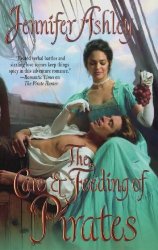
Welcome to my first Pirateologist General/ Mystery of Girls Media cross-post! what's it about, Pirates and Romance Novels! Prompted by People Magazine's hottest bachelors spread (one such pictured above).

Two serious cash cows for the entertainment industry. Why do they fit together like Peanut Butter and Jelly? Because they both embody an idealized noble savage, a man who is both wild, independent and rustic, but also, domesticatable and able to maintain hunkiness after months at sea being made leathery, amazingly gross and maintaining his heterosexuality in the face of well, months at sea, saving himself (in a lusty fashion) for an idealized woman who happens upon his path. While he may be a brute he secretly desires both feminine companionship, but also, feminine domination.

Now here's the rub,

Fantasy:

Reality: Ok, so also fictional and from a movie, but don't try to google an image of "dirty pirate" it just doesn't find an image that helps my point.

The romance of the pirate in the romance novel is an abduction fantasy, where the brutish lustful pirate takes the noble lady (often in spirit and lineage) and then takes the noble lady. In the process, often revealing his inner turmoil and desire for a more meaningful relationship with her, in which she makes many decisions for him, he reads her mind and while still humping like amazingly endowed bunnies, build a life for themselves in an idealized future where they fill in the blanks of one another's lives. As fantasy, excellent, wish fulfilling and fulfilling all the way to the bank.

While historically questionable, and until holding one's escapist fantasies to strict standards of historical accuracy is en vogue, it's not going to change any time soon. But! that doesn't mean that there isn't much to be done with the formula to make it new again. While there are some classic governor's daughter romances with randy swashbucklers being remade, the true test of the genre is the megalithic Pirates of the Caribbean franchise.

Look at that! you have two heartthrobs one dirty and hunky, one clean and hunky! they have a seriously tempestuous love triangle with a Governor's Daughter who is obsessed with the romantic notion of pirates, who eventually becomes Pirate King herself. Nice. Covers every base, and plays with the genre, satirizing it at points without abandoning its conventions.

Why does Pirates of the Caribbean fit the romantic pirate fantasy and say... Cutthroat Island, fail so miserably? Well, aside from the cleverness of the writing in general, the problem in Cutthroat Island is primarily one of the power dynamic.

In Pirates of the Caribbean, the protagonist, Elizabeth Swann, is a real match for the men around her while being able to handily maneuver through social currents of polite society and impolite society. This factor is an important aspect of the modern lady's aspirations. She is an equal member of the pirate crews and the shifts in power did not make her too weak or put any male in a position over her that she had no hand in creating. This creates an air of choice and real validation of her as a character and a person, rather than a waif or a harpy.

Cutthroat Island's protagonist, Morgan Adams, is a bit of a shrew. She's caustic and constantly coming at people from a position of inferiority because of her gender that undermines her aspirational qualities. Her crew doubts her and undermines her, but she's also a captain without having risen through the ranks, there is a sense that she hasn't earned the post. Where Elizabeth tends to defer to other people's knowledge but stand up for what she knows to be true and right, giving her a greater sense of legitimacy than Morgan, who tries to bulldoze her way through most problems.

What does this have to do with Romance Novels? a lot. Romance novels are all about the fantasy, who you want to be, who your idealized mate might be, and how that might come together in a volcano of fiery passion. They are a strong example of aspirational driving, the desire to be beautiful, desired, noble, and powerful in the face of other powerful people (even if that only manifests as making a man a slave to his lust), but also the desire for a man to be strong, a leader of others, to be passionate and to have something going on underneath his ruggedly handsome exterior.

So, what have we learned from Romance Novels and Pirates that can be applied to franchises for women in general? 1) Aspirational Fantasy Sells, 2) A man who can be hunky while caked in gross dirt is REALLY hot, 3) when considering power dynamics, gender equality trumps female supremacy.

Tuesday, September 14, 2010

Greatest Hits 2! My Most Read Post.

Perhaps it's because it's so ranty, perhaps it's because of that pretty butterfly picture, but this is analytically my most popular post, Enjoy:


Thursday, March 26, 2009

Rant: Specialization


Cartoon Network is going to start making "reality" shows. I enjoy Cartoon Network's shows, and if I think to myself, "Gosh, I want to watch a cartoon" chances are I'll look at Cartoon Network. It covers its niche well, from kids shows to the highly lauded and successful Adult Swim and late night Anime. But no, not good enough for them to be a highly successful Cartoon showing network. Variety reports that Cartoon Network is producing 4 reality shows out of the 13 new shows on their new slate and partnering with the NBA to produce a short form segment.
The NBA tie-in is likely a response to Disney XD's much-publicized partnership with ESPN. Disney XD is seeking to wrest the 6-11 boys demo from Cartoon, but it faces an uphill battle. Cartoon's focus on boys over the past year has earned it further dominance over its target aud, traditionally the most lucrative kid demographic for advertisers. The presentation was filled with thinly veiled refs to "the kind of sanitized shows you see from the competition," as more than one exec put it.
Seriously? you're feeling threatened by Disney XD's tie-in? they're trying to wrest the demo from you!!! The fact that they are doing better in comparison to you does not mean they are better at what you're doing than you are. In an attempt to capture the all too exciting boys 6-11 demo these two seem to be in a Red Queen (you should read this book) race to nowhere.

Understandably with the Ad Model falling on its face and viewership falling in general, it is logical that networks might feel insecure. But from an evolutionary perspective, once an organism has demonstrated a characteristic that makes it thrive, it passes on its successful traits to offspring. The reason for Offspring is then to further test that trait, to proliferate a successful adaptation. Cartoon Network should not be watering down its brand with non-cartoon knock offs of other shows.
Turner Broadcasting should be utilizing the lessons it could learn from Cartoon Network's success and expand into additional niche markets. Something else happens when a trait is ignored and no offspring are created: the trait disappears from the gene pool. In the frenzy to gain the broadest audience, they may sacrifice what made the original worth while, that it was a highly successful specialist.

If they have enough talent to create new programming in a different style for kids, they should be making a new network that would serve as a generalist: TBS Kids, TBA, TNBA; or add more kids programming to the CW. Frankly put, Cartoon Network should not be Turner's generalist unless the reality shows are animated.