Showing posts with label Amelia. Show all posts

Thursday, May 26, 2011

Hue and Cry: The Success of Bridesmaids

Every so often a movie comes along that makes a good portion of the blog-o-press-o-sphere froth at the mouth about the position of women in Hollywood (for example, Amelia) and there is a sense of stress and doom applied as though this one movie may validate or invalidate female creators/writers/funny people/etc... In my opinion, these sorts of events are the things that ulcers are made of.

That said, I'm interested in why a movie like Bridesmaids gets the Hue and Cry treatment, when it inhabits a fairly clear niche in the entire genre of "lady films". Is it that the film was not being marketed in the same upbeat movie cat-fighting advertising that accompanied say: Bride Wars?


Lets be fair, Bride Wars is a PG movie with a Tomatometer rating of 11% described as "Bride Wars takes the already wearisome concept of battling bridezillas, and makes it thoroughly insufferable via a lazy script and wholly detestable characters." and Bridesmaids rates an 89% on the Tomatometer and is described as "A marriage of genuine characters, gross out gags, and pathos, Bridesmaids is a female-driven comedy that refuses to be boxed in as Kristen Wiig emerges as a real star." So, quality of script is clearly a factor, as is the ambitiousness of the boundaries of the "Wedding Movie Genre."

Lets take a sideline and discuss wedding movies in general. A subsection of the romance genre usually, there are a few highly successful and many less successful wedding movies out there. My Best Friend's Wedding, Made of Honor, 27 Dresses, Father of the Bride, etc... They all feature the event, which is one that even if an individual never gets married, they will probably attend or participate in at some time in their lives. Add a dash of the sheer complexity and expense of these events, the potential emotional tribulations that surround them and there you have a movie.


But that's just movies, there are literally networks devoted entirely to wedding shows, Bridezillas, Rich Bride, Poor Bride, A Wedding Story, Wedding SOS, not to mention Bridalplasty.

The preoccupation with marriage, the event, landing a partner, and of course, the temporary insanity that seems to descend on otherwise reasonable women, the bridezillas, is a genre that clearly has market value. Deliciously traditional with a dash of "every girl wants to be a princess" it is a "safe" genre for stories.  


Bridesmaids set out to give that genre a sharp shock.
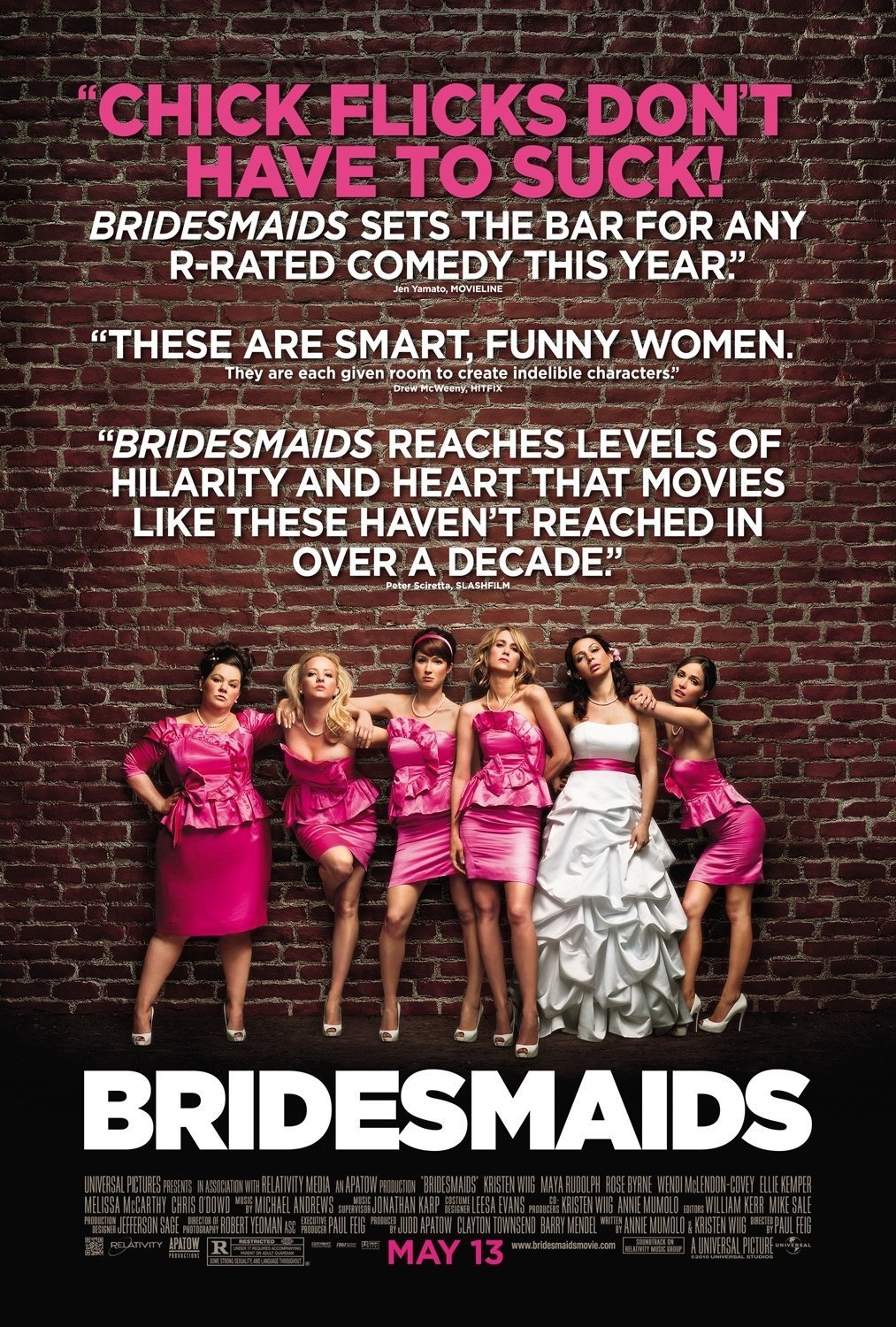


Kristin Wiig and writer, Annie Mumolo, had a charming and funny script that was then blended with Judd Apatow and Paul Feig's comedic stylings.  
If Apatow was going to make a movie with Kristen Wiig, he made it clear, he wanted to capture the outrageousness that had made her a television star. “No, we’re not going to sit and talk,” Mumolo remembers Apatow saying about one scene of sedentary dialogue. The two female writers were occasionally wary about some suggestions made by Apatow and Feig — like a scene in which the bride and most of the bridesmaids come down with violent food poisoning. What were Wiig’s reservations? She shot a look. “Just that it was a huge scene about women vomiting” and defecating in their pants. “We wrote the script, and we didn’t really have anything in that tone, and it seemed to be such a big statement,” she says. Apatow assured her that if it did not work, they could cut it. Wiig and Mumolo — a writing partner from her Groundlings days — ultimately agreed that it did work. 
Paul Feig as director seemed to mediate the female voice and often over the top comedy elements:
From a Wall Street Journal interview with Paul Feig:
Because so many big female-driven comedies can be watered-down versions of male ones, how careful did you have to be to make sure that it wasn’t going to be a really funny girl version of “40-Year-Old Virgin”?

What it just adds up to is they’re women talking like women and we’re not grafting anything on them other than potential story points or moments. Early on with Kristen and Annie and there were other women, we checked to make sure those story points were honest – what would be your honest reaction to this? And so it just kept us honest the whole time. I honestly don’t see how you can do it any other way if you’re working with a member of the opposite sex. Because I’m a pretty feminized geek, you know? I have that point of view, I grew up around a lot of girls, so I’m pretty sensitive to that. But I don’t dare say “I know how women think.”
So, what do we see here? People of both genders thinking about what they're doing and considerately making a movie that clearly appeals beyond the traditional market boundaries of the "Chick Flick." There was also a concerted effort to describe the film in a way that was accurate to its content. It isn't a standard chick flick, but while these ladies are sexy, they didn't single out the 'prettiest' and tart her up, nor did they attempt to overemphasize the scale of the shenanigans they get up to for shtick
Honestly, who wouldn't squish down their hair in that pose?
(example mug shots of me being wrong in the comments, please.)

So, Bridesmaids' budget was $34 Million, and in its opening weekend it made over $24 Million, outperforming it's studio's estimates. Good for it. According to Deadline Hollywood the audience was 67% female vs. 33% male, and 63% of the audience age 30 and older vs. 37% under age 30."
Universal crowed: "Bridesmaids has broken new ground in presenting an R-rated comedy designed for female audiences that also plays with male moviegoers – as opposed to traditional films in the R–rated comedy genre being targeted primarily for men. The film’s bigger than expected opening puts it in the category with other sleeper R-rated comedy openings such as The 40-Year-Old Virgin ($21.4m / $109.4m)."

I was so convinced that this rare R-rated event comedy featuring women burping and farting for our female amusement wouldn't make over $13M, even $15M tops, that I promised Universal Pictures chairman Adam Fogelson that I would leave Hollywood reporting forever if Bridesmaids did the $20+ million he thought it would. Well, I've called the moving vans because I clearly have no idea what works at the domestic box office anymore.
Nikki Finke is certainly not the only one surprised by the numbers, but that is a little sad.  The idea that with the talent and energy put into this movie it wouldn't do at least reasonably gives me a serious case of the beleaguered sighs.

Judd Apatow spoke to the The New York Times about what this means to women in the industry in general.
"Sadly, I think some of that talk was true. There are a lot of female-driven comedies on the bubble at the studios and they do look to measure how well these things do, and what levels of interest there are in certain genres. One of the reasons there was pressure is because the studios knew this movie came out very well, and if nobody bothered to go see it, they could say, "Even when you make a really good one, nobody comes." But because people came, the opposite lesson was learned, which is, there's an enormous neglected community of moviegoers who want to see films like this... I think they [the ensemble cast of Bridesmaids] all deserve to star in their own movies. It is usually a dearth of scripts which hold great actresses back. Hopefully the studios will develop more movies for them. As will I."
So, unlike Amelia in 2009, this lady-driven movie succeeded. Is it a factor in the sudden increase in female created scripts picked up for the fall TV lineup? (in my heart of hearts I hope not) Does it mean there should be a corresponding increase in scripts by ladies being picked up? only if they're good. It's a shame that every time a movie with a lot of female characters or writers or dare I say it, directors must stand exemplar for all women in the business. By that logic I demand we hold all movies by male directors to the standards of Bubble Boy and Battlefield Earth.

"Women must pay for everything. 
They do get more glory than men for comparable feats, 
but, they also get more notoriety when they crash."
-Amelia Earhart

It is my ardent hope that someday that quote will truly be the hallmark of an era that we have passed beyond.

Update: Bridesmaids is poised to become Judd Apatow's highest ever box-office hit 

Monday, October 26, 2009

Jezebel- How Do You Solve a Problem Like Amelia?


From Jezebel.com:
Well, for starters, how about having it actually be good? Oh, and throwing out "Strong Female Characters" (tm) once and for all?

It's unfortunate that we can't just talk about Amelia as a bad movie. As another unwieldy, under-characterized, over-cliched biopic trying to combine legend and humanity into one half-baked, generic panini, the kind made, inevitably, with chicken, crummy cheese and a few overwhelming hunks of roasted pepper. But when Amelia fails, it's an indictment of women's movie, of "older women's movies" (that's us ape-leaders over the magic 25) and of those with "strong female characters."

Sunday, October 25, 2009

Hue and Cry: Amelia Earhart Edition

"Women must pay for everything. They do get more glory than men for comparable feats, but, they also get more notoriety when they crash."
-Amelia Earhart
Hilary Swank's latest film, Amelia, is currently taking quite a critical drubbing, bad news for the film, and, as Ann Hornaday explores in today's Washington Post, for the increasingly small pool of strong female roles for women in Hollywood.

Hornaday argues that Amelia's box office results will essentially be a failure either way: "If 'Amelia' earns respectable receipts," Hornaday writes, "chances are it will be dismissed as a lucky break. If it fails, it will be cited as yet more proof that strong female protagonists are box office poison."

That's right, to have a strong heroine, not only does she have to be old and dead...

From the NY Times:

For actresses, it is no longer enough to be young and beautiful onscreen, they have to be dead and famous, too — one of history’s immortals. Filmmakers have long resurrected the dearly and notably departed with actors and actresses who flatter their memories, of course, partly because Academy members like to reward other success stories. Last year, Marion Cotillard warbled her way to the awards podium for her turn as Édith Piaf in “La Vie en Rose.” Since 2000, six of the best actress awards were for biographical performances, most of dead women. This year, Julia Child, Coco Chanel, Queen Victoria, Keats’s great love, Fanny Brawne, and now Amelia Earhart are all making a run for it.

You can’t blame filmmakers (or actresses) for raiding crypts. It’s rarely been more difficult to be a woman in the movies than now, particularly in the United States, where for the past few decades most blockbusters and microbudgeted D.I.Y. enterprises have been overwhelmingly male. Last year, only one movie about a woman — “Twilight,” the vampire romance about a living teenager and her undead but supercute boyfriend — squeezed into the ranks of the Top 10 grossing titles, a chart dominated by superheroes and male cartoon characters. Another two female-centric stories climbed into the Top 20. That sounds shocking except that only three such stories made it to the Top 20 in each of the previous two years.

...if you want to watch a movie about a powerful, interesting, difficult, believable, remotely recognizable woman these days she should certainly be famous and probably dead... Female stories have become so marginalized on American movie screens, we should be grateful filmmakers are raiding the history books.

... but even if the film is successful it will be dismissed as a fluke.

From the Washington Post:

Swank -- who also executive produced "Amelia" -- was optimistic. "I think things ebb and flow, and someone out there who crunches numbers probably affects that," she said regarding studios' reluctance to make films about strong women ("Amelia" was produced and distributed by Fox Searchlight Pictures, a subsidiary of Twentieth Century Fox). "Then I think art has to override it, and the numbers people say, 'Oh right, that works.' It comes in and out."

Strong women, for now anyway, are out. Two years ago, when the Jodie Foster vigilante thriller "The Brave One" failed at the box office, industry blogger Nikki Finke reported that a Warner Brothers production executive announced to staffers that the studio would no longer produce movies featuring female leads. This past summer, actress and writer Nia Vardalos blogged on the Huffington Post that when she was pitching a project to a studio executive, he asked that she change the female lead to a man. Why? Because "women don't go to movies," he told her. "When I pointed out the box office successes of 'Sex and The City,' 'Mamma Mia!,' and 'Obsessed,' he called them 'flukes,' " she wrote.

It is symptomatic of a production emphasis away from dramas in general:

"Dramas are dead," says producer Lynda Obst ("Contact," "The Invention of Lying"). "Some of the greatest parts for women -- the Academy Award parts for women -- are often in dramas, and this is the worst time for dramas since I've been in the business for the last 10,000 years." More than ever, Obst adds, the movie business is geared toward the young men who go to movies most frequently. "And by and large that's a comedy audience and an action audience. To get a project greenlit now, studios are requiring more and more what we call 'unaided awareness,' which is where you get this addiction to toys and comics and old titles. And dramas don't live there."

... One reason why we see fewer strong female leads these days is a changing business model, notes Silverstein. In the 1970s, 1980s and into the 1990s -- years when stars like Jane Fonda, Barbra Streisand, Sally Field and Goldie Hawn were making movies in a diverse number of genres -- studios were not, as they are now, subsidiaries of multi-corporations, responsible for contributing to quarterly bottom lines. With economic pressures greater than ever, studios are looking for movies that are guaranteed to make $100 million their first weekend out. The result: More Paul Blarts, fewer Erin Brockoviches.

The upshot, Obst says, is that "it's easier for male executives to get jobs now, because they want to develop male-oriented material. Girls don't grow up reading comic books or playing video games, or with Transformer or G.I. Joe toys. So the material they're looking for isn't necessarily as familiar to female executives who read books, which is becoming practically a liability. That's a real problem. That's how it becomes systemic."

I worry that the dialogue about the greater issue of women as an underserved market is that EVERY SINGLE MOVIE that stars a women becomes the life or death of women in the entertainment industry.

I'm glad Amelia is prompting people to write about these issues, I obviously think they're important ones, but one bad video game movie (let's say Doom) didn't stop people from making video game movies, one low-grossing action movie starring Nick Cage (let's say Bangkok Dangerous) isn't going to stop Nick Cage making movies, or people from making action movies.

Let's take a step back from the cliff, not all movies starring strong female characters will be great, nor will all movies staring strong female characters will be ludicrously successful. Let's stop acting as though an individual failure, or even one film's success is the end all and be all of women in Hollywood. In the words of Amelia Earhart herself:

"Please know that I am aware of the hazards. I want to do it because I want to do it. Women must try to do things as men have tried. When they fail, their failure must be a challenge to others. "

So regardless of the whether not Amelia succeeds at the box office, male executives are getting better opportunities in the studio system, or what stories feature female characters or their quality; there is only one mentality that will ever get women into Hollywood, and female characters the same screen time as male counterparts...

"The most effective way to do it, is to do it."